Construction experience
At Cassidis Design & Build, I coordinate site activities, support trades, monitor workmanship and measurements, and assist in checking work against drawings and specifications.
Engineering ePortfolio · 2026
I am Lien-Chun (Alan) Lin, a final-year Civil Engineering (Honours) student at the University of Technology Sydney with practical construction experience in site supervision and trade coordination.
About me
My interest in civil engineering is strongly connected to the practical delivery of construction projects. I am particularly interested in how engineering drawings, technical decisions and site coordination are translated into safe, efficient and well-constructed outcomes.
Through university study and practical site experience, I have developed an appreciation for the importance of technical knowledge, communication, planning and attention to detail in successful project delivery.
At Cassidis Design & Build, I coordinate site activities, support trades, monitor workmanship and measurements, and assist in checking work against drawings and specifications.
Hospitality strengthened my communication, teamwork, adaptability and calm problem-solving—skills that transfer directly to a changing construction environment.
I aim to build a career in civil construction and site or project management, combining engineering judgement with practical leadership and project coordination.
Professional profile
Final-year civil engineering student combining technical education, construction-site experience and a practical approach to project delivery.
Cassidis Design & Build
Tasty Eating House
University of Technology Sydney · Expected December 2026
TAFE NSW, Hornsby
St Ives High School
Referees available upon request.
Internship reflection
My experience at Cassidis Design & Build connected engineering theory with the practical realities of construction and clarified the professional direction I want to pursue.
Before starting, I expected most of my experience to involve observing construction activities, assisting tradespeople and learning how building work is completed on site. As a civil engineering student, I was particularly interested in seeing how engineering drawings and plans are translated into actual structures.
I also expected the internship to connect my university knowledge with construction practice and help me understand site operations, construction sequencing and the responsibilities involved in construction and project management.
The reality was much more hands-on and involved greater responsibility than I initially expected. I prepared work areas, materials and tools, assisted tradespeople and used hand and power tools.
As I gained experience, I also supervised activities, coordinated trades and checked workmanship, measurements and site conditions against project drawings and specifications. I learned that construction is not simply about following drawings; it requires continuous coordination, communication, problem-solving and adjustment.
Planning and coordination: one trade's work often determines what another can do next, so preparation has a direct effect on project efficiency.
Attention to detail: small errors in measurements or workmanship can become larger problems, delays and additional costs if they are not identified early.
Safety and communication: an organised site supports safe, productive work, while clear communication helps translate drawings and specifications into coordinated construction outcomes.
I combine developing civil engineering knowledge with practical construction-site experience. My studies have developed my understanding of engineering principles, drawings and analytical problem-solving, while my work has shown me how they are applied in a live construction environment.
I bring practical experience in site coordination, drawing interpretation, site measurement and trade support, together with a willingness to learn, take responsibility and adapt when unexpected issues arise.
My internship strengthened my interest in civil construction and site or project management. I enjoy turning engineering ideas, drawings and technical requirements into real structures, communicating with different trades and contributing to coordinated project delivery.
My long-term goal is to become a well-rounded construction professional who can take increasing responsibility and contribute to projects that are safe, efficiently coordinated and successfully delivered from planning through to completion.
“The experience allowed me to move beyond theoretical learning and understand how engineering decisions, planning, communication and practical problem-solving come together on site.”
Final reflection
Selection criteria
Application for the Industrial Engineering Graduate Program.
Dear Hiring Manager,
Re: Industrial Engineering Graduate Program
I am writing to apply for the Industrial Engineering Graduate Program. As a final-year Bachelor of Civil Engineering (Honours) student at the University of Technology Sydney, I have developed a strong technical foundation alongside practical construction experience at Cassidis Design & Build. Through my current site role, I have gained hands-on experience in site supervision, trade coordination, drawing interpretation and monitoring work against project requirements.
I am particularly interested in beginning my professional engineering career in an environment where I can continue developing my technical knowledge, practical judgement and professional skills. My combination of engineering education, construction-site experience and willingness to take responsibility has prepared me to contribute effectively within a collaborative graduate environment.
During my work with Cassidis Design & Build, I identified a water pipe that had been installed too close to the intended finished grass level. The pipe needed to be approximately 250–300 mm below the finished surface so that it would remain protected after landscaping. Rather than allowing work to continue, I raised the issue with the builder and confirmed that the installation needed correction. After receiving approval, I contacted the plumber and arranged for the trench to be excavated further so the pipe could be repositioned at the appropriate depth.
The pipe was properly protected before subsequent work proceeded, reducing the risk of damage and future repair costs. This demonstrated the importance of carefully checking workmanship, escalating concerns appropriately and taking responsibility for correct construction.
After a ceiling had been completed, I noticed that several downlight openings had been made in incorrect locations during electrical installation. Before arranging repairs, I confirmed with the electrician that all affected electrical work was complete. I then contacted the gyprock contractor, explained which areas required patching and coordinated the timing so the repair would not interfere with other activities.
Clear communication between the trades allowed the ceiling to be repaired efficiently without unnecessary delay. This strengthened my understanding of the role communication and stakeholder coordination play in resolving site issues.
In my site role, I regularly coordinate and support three to four tradespeople working on different activities. On one occasion, a bricklayer required the exact position of a wall to be established before work could begin. I reviewed the construction drawings to determine the required offset from the footpath, then used a laser level and string line to establish a clear reference line.
By checking the drawings and establishing the correct set-out before construction, I supported accurate work and reduced the risk of rework. This demonstrated my ability to contribute as part of a team while also providing practical direction when leadership was required.
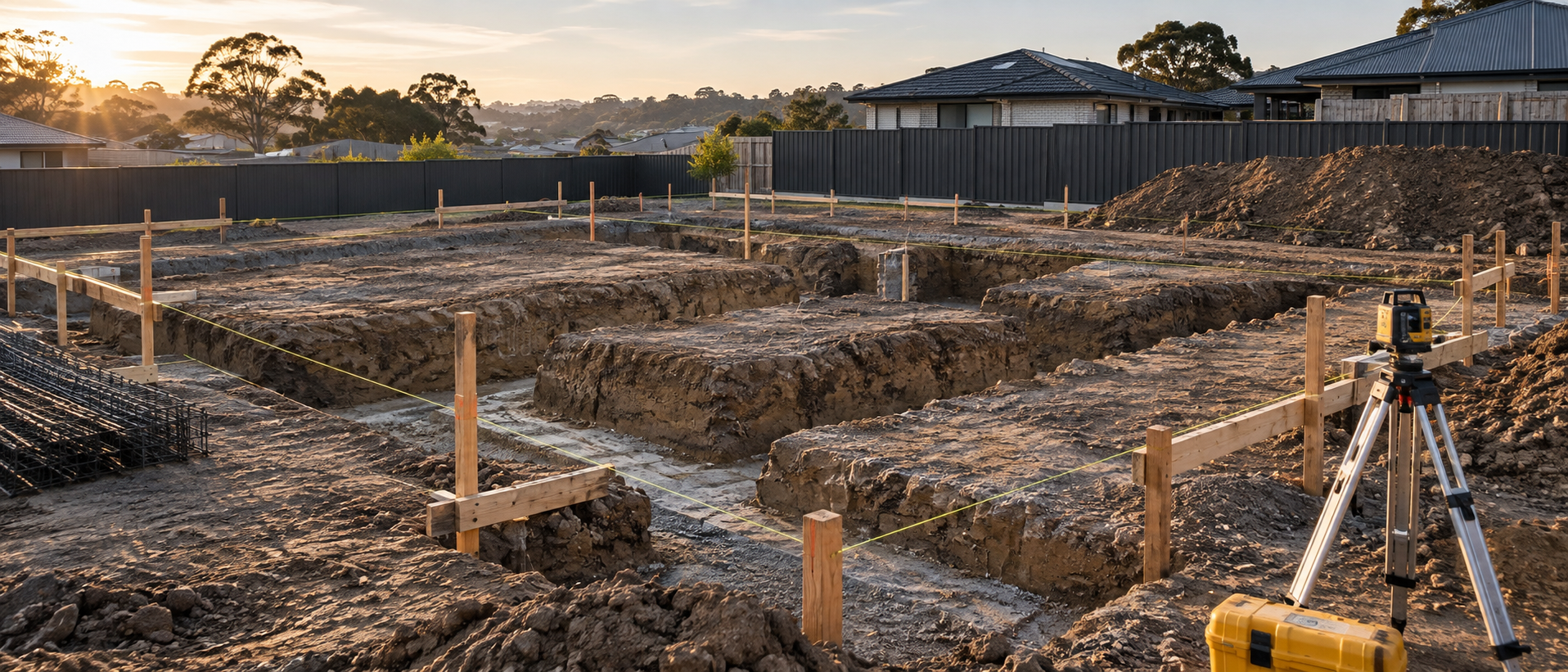
During preparation of footing trenches on an uneven site, only several reduced levels were available around the proposed wall locations. I set up a laser level using a known reduced level as a reference and transferred the required levels around the site. Once the excavation levels were established, I assisted with the set-out and levelling before trenching began.
Because the excavator operator could not achieve the exact depth using the machine alone, I proactively used an automatic dumpy level to check the excavation regularly and provide feedback. This helped ensure the trenches reached the required level and demonstrated my ability to apply engineering knowledge, adapt to site conditions and protect construction quality.
Working on site often requires me to manage several responsibilities at once, including checking trades, reviewing drawings, taking measurements and responding to unexpected issues. On one occasion, several trades were working in different areas while I was responsible for multiple site checks. I reviewed the day's priorities, identified activities requiring immediate attention and organised my tasks according to the construction sequence.
I kept notes of completed checks and outstanding items and updated the builder whenever clarification or approval was required. By organising my workload and taking responsibility for assigned tasks, I supported the trades and completed the necessary checks without delaying other work. This strengthened my ability to prioritise, work independently and maintain a professional standard in a busy environment.
Through my studies and practical experience, I have developed a combination of technical knowledge, construction experience, communication skills and practical problem-solving ability. I am eager to continue developing these capabilities within a professional graduate environment and contribute positively to your organisation.
I would welcome the opportunity to discuss my application further. Thank you for considering my application.
Kind regards,
Lien-Chun (Alan) Lin
Let's connect